

Global Catalysts for Bio-Jet Fuel Market Set for Sustained Growth Through 2036 as Aviation Accelerates Decarbonization
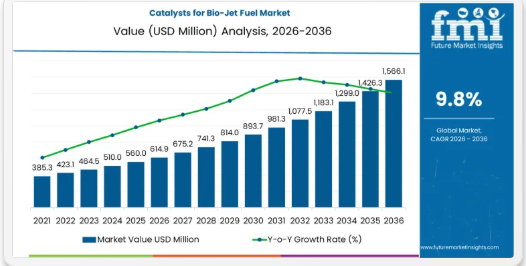
Bio-jet fuel catalyst demand rises as aviation decarbonization, SAF scale-up, and refining technologies reshape global fuel production.
NEWARK, DE, UNITED STATES, January 19, 2026 /EINPresswire.com/ -- The global catalysts for bio-jet fuel market is expected to experience sustained expansion over the next decade, driven by the aviation sector’s accelerating transition toward sustainable aviation fuel (SAF). As airlines, fuel producers, and governments align around long-term emissions reduction targets, demand for advanced catalyst technologies enabling efficient bio-jet fuel production continues to rise.
The market is projected to grow steadily between 2026 and 2036, supported by increasing SAF capacity additions, expanding refinery retrofits, and growing commercial adoption of certified bio-jet fuel pathways across major aviation hubs worldwide.
What Are Catalysts for Bio-Jet Fuel
Catalysts for bio-jet fuel are specialized materials used in chemical and refining processes that convert bio-based feedstocks—such as waste oils, fats, and biomass-derived intermediates—into aviation-grade fuel. These catalysts enable critical reactions including hydrogenation, deoxygenation, isomerization, and hydrocracking, ensuring the resulting fuel meets stringent aviation safety, performance, and certification standards.
Their role is central to the commercialization of SAF, as they directly influence conversion efficiency, fuel yield, operating costs, and product consistency.
Who Is Driving Market Development
The market includes a range of established chemical manufacturers, refinery technology licensors, and catalyst specialists supplying tailored solutions for bio-jet fuel production. These organizations support airlines, refiners, and energy companies seeking scalable and certifiable SAF production pathways compatible with existing infrastructure.
Collaboration between catalyst suppliers, process licensors, and fuel producers has become a defining feature of the market, particularly as production volumes increase and regulatory scrutiny intensifies.
Where Growth Is Occurring
Demand for bio-jet fuel catalysts spans North America, Europe, Asia Pacific, Latin America, and the Middle East & Africa. Regions with strong SAF policy frameworks, aviation traffic growth, and refinery modernization programs are emerging as key markets.
Countries investing heavily in renewable fuel infrastructure and low-carbon aviation strategies are driving adoption, with growth supported by long-term airline procurement agreements and public-private partnerships.
Why the Market Is Expanding
Several structural factors are shaping long-term demand:
• Aviation Emissions Reduction: Airlines face mounting pressure to decarbonize operations while maintaining fleet compatibility, making SAF a near-term solution.
• Regulatory and Policy Support: Blending mandates, emissions reduction targets, and sustainability frameworks are accelerating SAF deployment.
• Fuel Certification Requirements: Strict aviation fuel standards increase reliance on high-performance catalysts that deliver consistent molecular composition.
• Feedstock Diversification: The need to process variable bio-based feedstocks elevates demand for catalysts with improved tolerance and durability.
How Technology and Processes Are Evolving
Hydroprocessed pathways, including HEFA-based routes, remain the dominant production method due to their technical maturity and compatibility with existing refinery assets. Hydrotreating and hydrocracking catalysts account for a significant share of overall demand, reflecting their essential role in producing jet-range hydrocarbons.
Technology development increasingly focuses on extending catalyst life, improving selectivity, reducing hydrogen consumption, and minimizing sensitivity to feedstock impurities. These performance attributes are critical for improving plant economics and enabling large-scale SAF deployment.
Market Challenges and Competitive Dynamics
Despite favorable growth prospects, the market faces ongoing challenges. Feedstock variability can impact catalyst stability, while process economics require careful optimization to balance yield, energy use, and operational reliability. In addition, long qualification and certification timelines for new catalysts can slow market entry.
As a result, competition centers on proven performance, process integration expertise, and long-term operational support rather than short-term pricing alone.
Strategic Importance for Industry and Investors
Catalysts for bio-jet fuel represent a foundational segment of the SAF value chain. Their adoption provides insight into the pace of aviation decarbonization, refinery investment cycles, and future SAF supply growth. For industry leaders, analysts, and investors, catalyst demand trends serve as an early indicator of scalable bio-jet fuel production and long-term market viability.
Request for Sample Report | Customize Report |purchase Full Report - https://www.futuremarketinsights.com/reports/sample/rep-gb-31527
Explore More Related Studies Published by FMI Research:
Fine Chemicals Market https://www.futuremarketinsights.com/reports/fine-chemicals-market
Personal Care Ingredient Market https://www.futuremarketinsights.com/reports/cosmetic-ingredients-market
Urea Formaldehyde Market https://www.futuremarketinsights.com/reports/urea-formaldehyde-market
About Future Market Insights (FMI)
Future Market Insights, Inc. (FMI) is an ESOMAR-certified, ISO 9001:2015 market research and consulting organization, trusted by Fortune 500 clients and global enterprises. With operations in the U.S., UK, India, and Dubai, FMI provides data-backed insights and strategic intelligence across 30+ industries and 1200 markets worldwide.
Why FMI: https://www.futuremarketinsights.com/why-fmi
Sudip Saha
Future Market Insights Inc.
+ +1 347-918-3531
rahul.singh@futuremarketinsights.com
Legal Disclaimer:
EIN Presswire provides this news content "as is" without warranty of any kind. We do not accept any responsibility or liability for the accuracy, content, images, videos, licenses, completeness, legality, or reliability of the information contained in this article. If you have any complaints or copyright issues related to this article, kindly contact the author above.
