

16.91% CAGR Puts RTLS in Healthcare Market at the Center of Hospital Digital Transformation
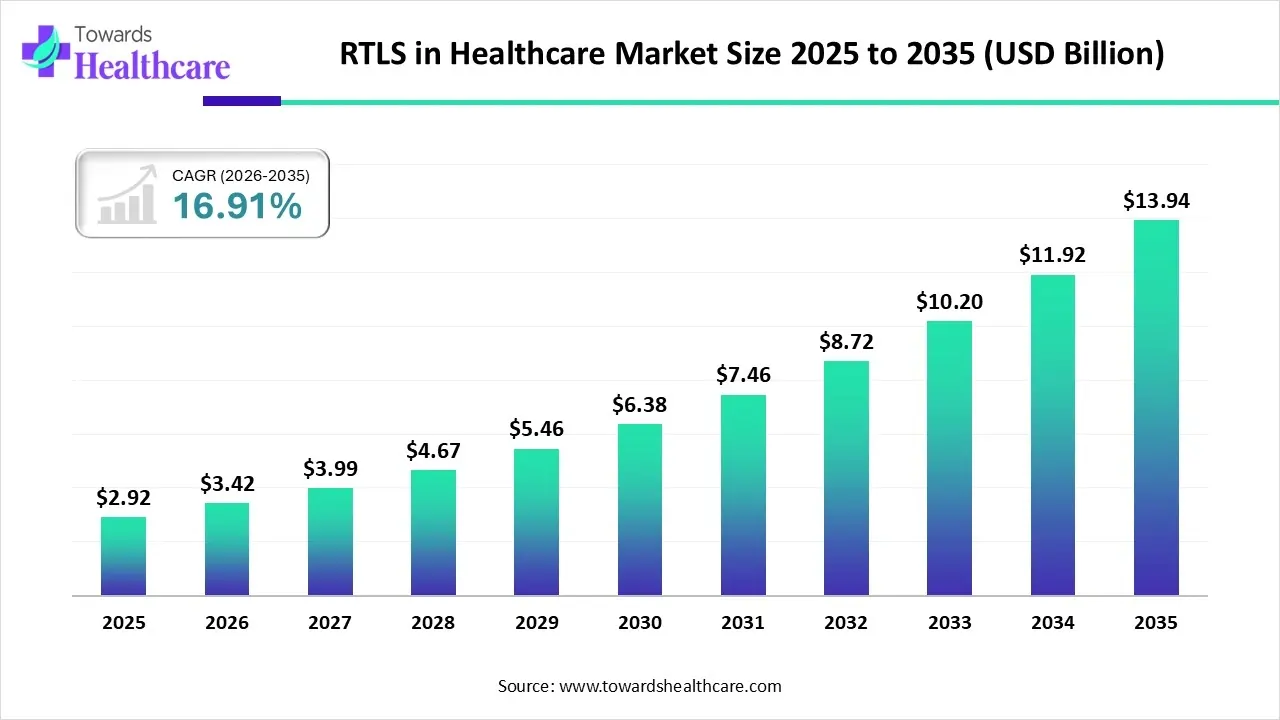
The global RTLS in healthcare market size was valued at USD 2.92 billion in 2025and is predicted to hit around USD 13.94 billion by 2035,rising at a 16.91% CAGR,a study published by Towards Healthcare a sister firm of PrecedenceResearch.
Ottawa, Feb. 26, 2026 (GLOBE NEWSWIRE) -- The global RTLS in healthcare market size is calculated at USD 3.42 billion in 2026 and is expected to reach around USD 13.94 billion by 2035, growing at a CAGR of 16.91% for the forecasted period.
Access a Personalized Sample Designed to Support Strategic Planning for Your Business | Download Now @ https://www.towardshealthcare.com/download-sample/6467
Key Takeaways
- RTLS in healthcare sector pushed the market to USD 2.92 billion by 2025.
- Long-term projections show a USD 13.94 billion valuation by 2035.
- Growth is expected at a steady CAGR of 16.91% in between 2026 and 2035.
- North America registered dominance in the RTLS in healthcare market in 2024.
- Asia-Pacific is expected to grow rapidly during the forecast period.
- By component, the hardware segment dominated the market in 2024.
- By component, the software segment is expected to be the fastest-growing in the studied years.
- By application, the asset tracking & management segment led the market in 2024.
- By application, the patient tracking & safety segment is expected to witness rapid expansion in the upcoming years.
- By deployment mode, the on-premise segment was dominant in the market in 2024.
- By deployment mode, the cloud-based segment is expected to grow at a rapid CAGR during 2026-2035.
- By end-user, the public hospitals segment captured a major share of the market in 2024.
- By end-user, the ambulatory surgical centers (ASCs) segment is expected to grow fastest in the predicted timeframe.
- By distribution channel, the direct sales segment dominated the RTLS in healthcare market in 2024.
- By distribution channel, the system integrators segment is expected to grow rapidly in the coming years.
Quick Facts Table
| Key Elements | Scope | |
| Market Size in 2026 | USD 3.42 Billion | |
| Projected Market Size in 2035 | USD 13.94 Billion | |
| CAGR (2026 - 2035) | 16.91 | % |
| Leading Region | North America | |
| Market Segmentation | By Component, By Application, By Facility Type, By Deployment Mode, By End-User, By Distribution Channel, By Region | |
| Top Key Players | Navigine, Cognosos, Idox, Vertiv, Kyndryl Healthcare Solutions, ARISTA, Blueiot, Litum | |
What is the Substantial Advancement in RTLS in Healthcare?
The RTLS in healthcare market covers wireless, indoor tracking technologies, which leverage tags, sensors, and software to instantly locate, track, and manage assets, patients, & staff. Nowadays, the market is pushing immersive breakthroughs in hybrid systems, which integrate technologies to facilitate the right level of accuracy for particular needs. This further includes Bluetooth Low Energy (BLE) + Angle of Arrival (AoA), which facilitates high precision (10 cm to 1 m) with minimal power consumption.
What are the Major Drivers in the RTLS in Healthcare Market?
A vital driver is the greater adoption of RTLS in hospitals, which supports preventing theft and lowers time spent searching for equipment, enhancing ROI. Also, these healthcare providers are highly demanding real-time tracking of medical equipment, patients, and staff to improve workflows.
You can place an order or ask any questions, please feel free to contact us at sales@towardshealthcare.com
What are the Key Drifts in the RTLS in Healthcare Market?
- In August 2025, Sonitor and Tagnos partnered to integrate Sonitor’s high-precision RTLS & Tagnos’s workflow intelligence software to revolutionize asset tracking, patient flow, and staff safety.
- In July 2025, Canopy joined with Commure to foster assistance for Commure Strongline customers and ensure continued innovation in staff safety.
What is the Significant Challenge in the RTLS in Healthcare Market?
Many healthcare providers are facing limitations in the integration of RTLS with legacy hospital IT systems and workflows, which results in interoperability concerns. Somehow, monitoring patients and staff are developing issues about data security, privacy compliance, & potential breaches.
Regional Analysis
What Made North America Dominant in the Market in 2024?
North America captured the largest share of the market, due to the numerous regional hospitals that are executing RTLS to monitor crucial equipment in real-time, lowering rental costs, loss, and equipment downtime. However, in California and Washington, real-time duress alerts in staff badges are becoming mandatory for workplace violence mitigation. Alongside, Ontario's provincial systems are highly combining RTLS in long-term care for wander management & automated fall detection.
For instance,
- In September 2025, Borda Technology & Plan Group collaborated to convey IoT Solutions for the new St. Paul’s Hospital in Canada.
In the U.S., RTLS adoption in healthcare is driven by smart hospital infrastructure upgrades, asset tracking, patient flow optimization, and safety improvements using RFID, BLE, and UWB technologies. Integration with IoT and digital systems enhances operational efficiency and supports clinical workflows.
How did the Asia Pacific Expand Notably in the Market in 2024?
In the coming era, the Asia Pacific is anticipated to expand fastest in the RTLS in healthcare market. Many investments in advanced hospitals and digital health infrastructure, especially in China and India, offer a strong platform for RTLS deployment. Moreover, the recent approaches by Chinese hospitals are widely feeding RTLS data into AI engines to develop digital twin models to enable predictive scheduling & the determination of care delays before they occur.
For instance,
- In September 2025, HID Global & InThing Corp joined to transfer real-time operational visibility across distinct manufacturing environments.
In China, RTLS growth is fueled by rapid healthcare digitization, government smart hospital initiatives, and expanding use of real-time tracking for assets, patients, and staff. Local technology development and rising demand for efficiency and safety create future opportunities across hospitals and eldercare facilities.
Get the latest insights on life science industry segmentation with our Annual Membership: https://www.towardshealthcare.com/get-an-annual-membership
Segmental Insights
By component analysis
Which Component Led the RTLS in Healthcare Market in 2024?
The hardware segment registered dominance in the market in 2024. This primarily encompasses tags, badges, sensors, and readers for tracking assets & personnel. Extensive breakthroughs include smart tags those integrated into UWB, BLE, and RFID for maximum flexibility in various hospital circumstances, which enables a single device to be used for multiple use cases.
On the other hand, the software segment is anticipated to register the fastest growth. The widespread implementation is fueled by increasing ROI from inventory management, IoT integration, and the requirement for workflow enhancement. Current advanced platforms are facilitating cloud-based, HIPAA-secured solutions to assist hybrid architectures and enable easy, scalable deployment.
By application analysis
Why did the Asset Tracking & Management Segment Dominate the Market in 2024?
In 2024, the asset tracking & management segment captured a dominant share of the RTLS in healthcare market. The use of real-time visibility enables tracking thousands of assets, which ensures that they are available when necessary and lowers loss. The exploration of novelty includes systems to track hand hygiene compliance by monitoring staff togetherness to sanitization stations, with certain facilities showing a 300% rise in hygiene adherence.
Whereas the patient tracking & safety segment will show the fastest growth. RTLS are increasingly offering instant, precise tracking, mitigating elopement, and securing vulnerable patients in conditions, such as dementia care & maternity wards. The market is extensively promoting novel, affordable solutions, which enable the utilization of standard iOS/Android devices as smart tags, which minimizes the requirement for expensive, promising wearables.
By deployment mode analysis
What Made On-premise Segment Dominant in the Market in 2024?
The on-premise segment led with a major share of the RTLS in healthcare market in 2024. The emergence of stricter regulatory guidelines for managing patient information makes on-premise systems appealing, as they offer comprehensive control over data ownership & security. Giant organizations are preferring this deployment as tis provide minimal latency, which is crucial for real-time tracking in vital situations, reducing reliance on external networks or internet connectivity.
Furthermore, the cloud-based segment is predicted to expand rapidly. Its greater adoption is spurred by its higher scalability, minimal upfront capital expenditures, and remote accessibility. Upcoming latest solutions are widely using existing Wi-Fi 6 or BLE-enabled access points to lower the need for installing novel proprietary sensors. The market is pushing AI to evaluate historical movement data, estimate concerns in patient flow and improve staff allocation before difficulties occur.
By end-user analysis
Which End-User Led the RTLS in Healthcare Market in 2024?
In 2024, the public hospitals segment was dominant in the market in 2024. They are widely using RTLS to promote automation of clinical and administrative workflows, which supports handling bed capacity and lowering patient wait times. Ongoing major hardware investments to subscription-based models (SaaS) with cloud-based analytics are making it as easy for public institutions with reduced budgets to adopt these technologies. Also, RTLS assists in evolving heat maps of activity to find infection hotspots, while also automating hand hygiene compliance monitoring.
Moreover, the ambulatory surgical centers (ASCs) segment is predicted to expand at a rapid CAGR. The adoption of RTLS in ASCs is fueled by a rise in the need for accurate tracking of surgical instruments & sterilization. They are using tags to attach to high-value, mobile equipment, like IV pumps, ventilators, portable X-ray units, and ultrasound machines, enabling staff to instantly deploy them via a dashboard, removing time spent searching.
By distribution channel analysis
How did the Direct Sales Segment Dominate the Market in 2024?
In 2024, the direct sales segment held the biggest share of the RTLS in healthcare market. Many leading firms, such as Zebra Technologies, Securitas Healthcare, and CenTrak, are leveraging direct sales to reach substantial hospital chains and healthcare facilities to execute, install, and help complex RTLS infrastructures. This is further enabling the use of cloud-based software for rapid deployment, easy scalability across various facilities, & remote management.
On the other hand, the system integrators segment will register the fastest growth. Many of them are facilitating an end-to-end, clinical-grade locating platform by utilizing different technologies, like infrared, BLE, Wi-Fi, to offer room-level accuracy for assets and patients, by combining with over 100 IT systems. They are moving towards cloud-based, subscription-based models (RTLS-as-a-Service) that lower upfront hardware expenses and speed up deployment frequencies.
Become a valued research partner with us - https://www.towardshealthcare.com/schedule-meeting
What are the Recent Developments in the RTLS in Healthcare Market?
- In January 2026, Kontakt.io launched Patient Flow Agent, a patient flow orchestration solution to support hospitals in constraining length of stay, eliminating delays, etc.
- In December 2025, Kontakt.io launched a novel artificial intelligence agent to allow health systems to dynamically enhance room assignments for outpatient care and reveal additional patient capacity.
- In May 2025, Litum unveiled PathAware, an innovative forklift safety solution to lower collision challenges and raise operational awareness.
Key Players List
- Navigine
- Cognosos
- Idox
- Vertiv
- Kyndryl Healthcare Solutions
- ARISTA
- Blueiot
- Litum
Browse More Insights of Towards Healthcare:
The global healthcare IT market was estimated at US$ 329 billion in 2025 and is projected to grow to US$ 1650.34 billion by 2035, rising at a compound annual growth rate (CAGR) of 17.5% from 2026 to 2035.
The global healthcare ERP market size is calculated at USD 8.57 billion in 2025, grew to USD 9.19 billion in 2026, and is projected to reach around USD 17.22 billion by 2035. The market is expanding at a CAGR of 7.23% between 2026 and 2035.
The global healthcare CDMO market size was estimated at USD 306.3 billion in 2025 and is predicted to increase from USD 337.3 billion in 2026 to approximately USD 803.17 billion by 2035, expanding at a CAGR of 10.12% from 2026 to 2035.
The global healthcare biometrics market size in 2024 was US$ 8.4 billion, expected to grow to US$ 9.86 billion in 2025 and further to US$ 41.38 billion by 2034, backed by a robust CAGR of 17.34% between 2025 and 2034.
The global healthcare supply chain management market size is calculated at USD 3.60 billion in 2025, grow to USD 4 billion in 2026, and is projected to reach around USD 10.27 billion by 2035. The market is expanding at a CAGR of 11.05% between 2026 and 2035.
The global healthcare staffing market size is calculated at US$ 45.22 billion in 2025, grew to US$ 48.37 billion in 2026, and is projected to reach around US$ 88.7 billion by 2035. The market is expanding at a CAGR of 6.97% between 2026 and 2035.
The global healthcare cold chain logistics market size is calculated at USD 59.97 in 2024, grew to USD 65.14 billion in 2025, and is projected to reach around USD 137.13 billion by 2034. The market is expanding at a CAGR of 8.63% between 2025 and 2034.
The global hospital electronic health records market size was estimated at USD 18.55 billion in 2025 and is predicted to increase from USD 19.39 billion in 2026 to approximately USD 28.94 billion by 2035, expanding at a CAGR of 4.55% from 2026 to 2035.
The global telehealth market size is calculated at USD 153.84 billion in 2025, grew to USD 191.88 billion in 2026, and is projected to reach around USD 1402.1 billion by 2035. The market is expanding at a CAGR of 24.73% between 2026 and 2035.
The global quantum computing in healthcare market size reached USD 167.64 million in 2025, grew to USD 231.11 million in 2026, and is projected to hit around USD 4156.76 million by 2035, expanding at a CAGR of 37.86% during the forecast period from 2026 to 2035.
Segments Covered in the Report
By Component
- Hardware
- Tags
- Readers
- Sensors
- Software
- Location Tracking Platforms
- Analytics Dashboards
- Services
- Installation
- Integration
- Maintenance
By Application
- Asset Tracking & Management
- Staff Location & Workflow Optimization
- Patient Tracking & Safety
- Inventory & Supply Chain Management
- Infection Control & Hygiene Monitoring
- Contact Tracing
By Facility Type
- Hospitals
- Specialty Clinics
- Nursing Homes & Long-term Care Facilities
- Diagnostic Centers
- Research Laboratories
By Deployment Mode
- On-premise
- Cloud-based
- Hybrid
By End-User
- Public Hospitals
- Private Hospitals
- Ambulatory Surgical Centers (ASCs)
- Long-term Care Facilities
- Research & Academic Institutes
By Distribution Channel
- Direct Sales
- System Integrators
- Value-added Resellers
- Online Platforms
By Region
- North America
- US
- Canada
- Mexico
- Rest of North America
- South America
- Brazil
- Argentina
- Rest of South America
- Europe
- Western Europe
- Germany
- Italy
- France
- Netherlands
- Spain
- Portugal
- Belgium
- Ireland
- UK
- Iceland
- Switzerland
- Poland
- Rest of Western Europe
- Eastern Europe
- Austria
- Russia & Belarus
- Turkiye
- Albania
- Rest of Eastern Europe
- Western Europe
- Asia Pacific (APAC)
- China
- Taiwan
- India
- Japan
- Australia & New Zealand
- ASEAN Countries (Singapore, Malaysia)
- South Korea
- Rest of APAC
- Middle East and Africa (MEA)
- GCC Countries
- Saudi Arabia
- United Arab Emirates (UAE)
- Qatar
- Kuwait
- Oman
- Bahrain
- South Africa
- Egypt
- Rest of MEA
- GCC Countries
Purchase the Complete Premium Report and Stay Ahead of Your Competitors | Buy Now @ https://www.towardshealthcare.com/checkout/6467
Access our exclusive, data-rich dashboard dedicated to the healthcare market - built specifically for decision-makers, strategists, and industry leaders. The dashboard features comprehensive statistical data, segment-wise market breakdowns, regional performance shares, detailed company profiles, annual updates, and much more. From market sizing to competitive intelligence, this powerful tool is one-stop solution to your gateway.
Access the Dashboard: https://www.towardshealthcare.com/access-dashboard
About Us
Towards Healthcare is a leading global provider of technological solutions, clinical research services, and advanced analytics, with a strong emphasis on life science research. Dedicated to advancing innovation in the life sciences sector, we build strategic partnerships that generate actionable insights and transformative breakthroughs. As a global strategy consulting firm, we empower life science leaders to gain a competitive edge, drive research excellence, and accelerate sustainable growth.
You can place an order or ask any questions, please feel free to contact us at sales@towardshealthcare.com
Europe Region: +44 778 256 0738
North America Region: +1 8044 4193 44
APAC Region: +91 9356 9282 04
Web: https://www.towardshealthcare.com
Our Trusted Data Partners
Precedence Research | Towards Packaging | Towards Food and Beverages | Towards Chemical and Materials | Towards Dental | Towards EV Solutions | Healthcare Webwire
Find us on social platforms: LinkedIn | Twitter | Instagram | Medium | Pinterest
Also Read:
https://www.towardshealthcare.com/insights/pharmacy-automation-devices-market-sizing
https://www.towardshealthcare.com/insights/agentic-ai-in-healthcare-market-sizing
https://www.towardshealthcare.com/insights/oncology-clinical-trial-monitor-market-sizing
https://www.towardshealthcare.com/insights/laboratory-information-management-systems-market-sizing
https://www.towardshealthcare.com/insights/pharmaceutical-electronic-distribution-market-sizing
https://www.towardshealthcare.com/insights/healthcare-digital-authentication-market-sizing
https://www.towardshealthcare.com/insights/e-clinical-trials-market-sizing
https://www.towardshealthcare.com/insights/artificial-intelligence-in-drug-discovery
https://www.towardshealthcare.com/insights/healthcare-revenue-cycle-management-market-sizing


Legal Disclaimer:
EIN Presswire provides this news content "as is" without warranty of any kind. We do not accept any responsibility or liability for the accuracy, content, images, videos, licenses, completeness, legality, or reliability of the information contained in this article. If you have any complaints or copyright issues related to this article, kindly contact the author above.
