

Polyphenylene Sulfide Market Surges to USD 2.45 Billion by 2032 as High-Performance Polymer Gains Across EVs and 5G
Polyphenylene Sulfide Market
When heat cannot be an excuse and chemicals cannot win, one polymer quietly becomes the architecture of the future.
“Polyphenylene sulfide does not compete with metals, it replaces the logic of using them,” says Maximize Market Research.”
ROCKVILLE , MD, UNITED STATES, April 21, 2026 /EINPresswire.com/ -- WHAT HAPPENS WHEN A POLYMER BEATS BOTH METAL AND PEEK? The USD 2.45 Billion Answer Is Polyphenylene Sulfide— Maximize Market Research
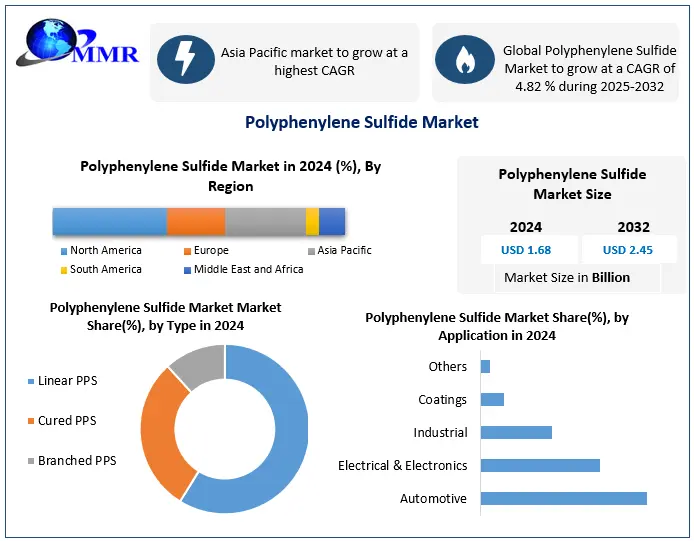
Global Polyphenylene Sulfide Market was valued at USD 1.68 Billion in 2024 and is projected to reach USD 2.45 Billion by 2032 at a CAGR of 4.82%. The Polyphenylene Sulfide Demand Forecast is anchored by this high-temperature engineering thermoplastic, with a melting point near 280°C, intrinsic flame retardancy, and near-zero moisture absorption, making it a critical enabler for industries demanding dimensional precision under thermal stress and chemical aggression. The PPS Market Share 2026 is structurally driven by the automotive electrification wave as demand for PPS-based EV components grew 18% in 2025 as OEMs replaced metal housings with precision-molded polymer assemblies. Linear Polyphenylene Sulfide dominates with 59% revenue share, prized for its superior crystallinity in injection-moulded under-hood assemblies, sensor housings, and battery thermal management structures.
Get Full PDF Sample Copy of Report: (Including Full TOC, List of Tables & Figures, Chart) @ https://www.maximizemarketresearch.com/request-sample/280918/
WHY IS EVERY OEM RACING TO SPECIFY PPS? Three Forces Driving Polyphenylene Sulfide Market Size
The Polyphenylene Sulfide Market Size is expanding as PPS transitions into a strategic industrial input. Three forces define this shift:
EV Electrification: Mandatory metal-to-plastic replacement in thermal management offers 30-45% weight reduction over aluminum.
5G Infrastructure: High demand for low-warpage, halogen-free connectors that maintain signal integrity.
Industrial Coatings: A shift toward chemical-resistant thermoplastics as regulations tighten on solvent-based alternatives.
WHY CAN'T PPS SCALE FASTER? The Supply Concentration and Compliance Barriers Slowing Growth
Scale is currently limited by high capital barriers and raw material concentration. With Toray (18%) and DIC Corporation (15%) dominating capacity, supply chain diversification is difficult. Dependence on price-volatile petrochemicals and the 2026 EU Digital Product Passport, which mandates end-of-life polymer traceability, create significant compliance pressures for manufacturers navigating the PPS Market Demand landscape through 2032.
CAN PPS DETHRONE PEEK? Why 60-70% Lower Cost Is Triggering an Asia-Pacific Production Explosion
The cost-competitiveness of PPS vs. PEEK is the market's most consequential commercial dynamic. At 60-70% lower cost per kilogram while retaining comparable thermal stability below 240°C, PPS is displacing PEEK across aerospace and industrial pump applications. Asia-Pacific polyphenylene sulfide production capacity is expanding rapidly: Toray received Malaysian government approval in Q2 2025 to double its Penang PPS resin facility, while SABIC expanded regional distribution across Southeast Asian electronics clusters. The PPS recyclability agenda is unlocking new institutional procurement across EV and industrial segments.
WHERE DOES PPS ACTUALLY MAKE MONEY? Segment Breakdown of Global Polyphenylene Sulfide Revenue
The Global Polyphenylene Sulfide Market is segmented by type, application, and region. By type, linear PPS dominates with 59% revenue share, while cured and branched grades serve niche high-viscosity moulding applications. By application, the automotive segment commands 34% share, supplying EV powertrain systems and under-hood components. Electrical and electronics PPS is the fastest-growing application, driven by miniaturisation in 5G base station infrastructure. Industrial coatings PPS and appliance applications represent stable base-load demand.
By Type
Linear Polyphenylene Sulfide (PPS)
Cured PPS
Branched PPS
By Application
Automotive
Electrical & Electronics
Industrial
Coatings
Others
By Region
North America
Europe
Asia-Pacific
Middle East & Africa
South America
Get Full PDF Sample Copy of Report: (Including Full TOC, List of Tables & Figures, Chart) @ https://www.maximizemarketresearch.com/request-sample/280918/
WHO CONTROLS THE PPS MAP? Asia-Pacific Owns Volume, North America Owns the Premium
Asia-Pacific: Dominant Market Leader
Asia-Pacific commands a 36% revenue share, driven by China, Japan, and South Korea's deep integration into automotive and electronics supply chains. Accounting for over three-quarters of global PPS consumption, the region benefits from cost-competitive raw materials and dense OEM clusters. India's expanding electronics ecosystem is fostering a new structured demand corridor through 2032.
North America: Fastest-Growing Premium Corridor
North America leads in premium growth, fueled by aerospace innovation, EV infrastructure, and strict environmental mandates. The region is transitioning toward high-value partnerships, exemplified by DIC Corporation's 2025 Bosch contract for advanced sensor housings, validating North America's shift toward specification-locked, long-term engineering thermoplastics supply agreements.
HOW FAR CAN PPS GO? Four Application Breakthroughs Redefining the Ceiling Through 2032
EV Thermal Backbone
Solvay's 2024 Hyundai agreement shifted PPS from a simple substitute to a strategic EV material, validating it as the primary lightweight, heat-resistant solution for battery separators and high-voltage connectors across global EV platforms.
5G Signal Precision
Solvay's Q3 2024 high-flow Ryton PPS resin, engineered specifically for 5G base stations, signals the transition to grade-specific supply agreements, anchoring a vital new telecommunications demand corridor through 2032.
Aerospace Light-Weighting
Tosoh Corporation's 2025 R&D surge secured major OEM contracts, positioning high-strength PPS as the market's highest-margin application for engine adjacencies, directly challenging PEEK and aluminum in structural aerospace roles.
Sustainable Formulations
SK Chemicals' 2024 eco-friendly PPS grade for EV batteries combines thermal stability with recyclability, providing a compliance-ready solution for OEMs navigating the 2026 EU Digital Product Passport mandate.
WHO WINS THE PPS MARKET REVENUE RACE? Toray Owns Capacity, Solvay Owns Applications, Asia Owns Cost
The Polyphenylene Sulfide Market is accelerating toward USD 2.45 Billion by 2032 on a 4.82% CAGR. From EV thermal systems to 5G infrastructure, PPS Market Revenue is expanding as industries replace heavy metals with precision-engineered polymers. With Asia-Pacific powering production and the 2026 EU Digital Product Passport mandating total traceability, the competitive moat belongs to manufacturers who secure OEM specification contracts before the 2027 lock window closes.
Polyphenylene Sulfide Market Key Players:
Toray Industries, Inc.
Solvay S.A. (Syensqo)
DIC Corporation
SK Chemicals (Initz Co. Ltd.)
Polyplastics Co., Ltd.
Kureha Corporation
Celanese Corporation
Tosoh Corporation
NHU Materials Co., Ltd.
LG Chem Ltd.
SABIC
Idemitsu Composites Co., Ltd.
Zhejiang NHU Co., Ltd.
TEIJIN Limited
Chengdu Letian Plastic Co., Ltd.
Get access to the full description of the report @ https://www.maximizemarketresearch.com/market-report/polyphenylene-sulfide-market/280918/
Key Recent Developments in the Global PPS Market
Q2 2025: Toray Industries received Malaysian government approval to double PPS resin capacity at its Penang facility, supporting Southeast Asian electronics and automotive growth corridors and signalling Asia-Pacific's structural supply expansion through 2032.
Q1 2025: DIC Corporation secured a multi-year PPS compound supply contract with Bosch for automotive electronics and sensor housings, the first major specification-locked OEM anchor contract in the European advanced automotive PPS segment.
Q3 2024: Solvay launched high-flow Ryton PPS resin engineered for 5G base station components, addressing the telecommunications industry's demand for enhanced processability, heat resistance, and signal-integrity-grade dimensional precision.
Q2 2024: SK Chemicals introduced an eco-friendly PPS grade for EV battery modules, combining improved recyclability with thermal stability, directly pre-empting the EU's Digital Product Passport traceability requirements set for 2026 implementation.
Q1 2024: Solvay signed a multi-year PPS supply agreement with Hyundai Motors, supporting lightweight, heat-resistant component integration across Hyundai's EV platform roadmap and establishing the automotive OEM-level PPS supply contract as an industry template.
FAQs: Global Polyphenylene Sulfide Market
Q1. What defines the current Polyphenylene Sulfide Market Size?
Ans. The market was valued at USD 1.68 Billion in 2024, projected to reach USD 2.45 Billion by 2032, driven by industrial metal-to-plastic transitions in EV thermal management, 5G telecommunications, and aerospace applications at a 4.82% CAGR.
Q2. What drives the surging PPS Market Revenue?
Ans. Growth is fueled by the 4.82% CAGR specifically through high-performance applications in electric vehicle thermal management and 5G telecommunications infrastructure, alongside the cost-competitiveness advantage of PPS vs. PEEK at 60-70% lower cost per kilogram.
Q3. What is the Polyphenylene Sulfide Demand Forecast for automotive applications?
Ans. Automotive remains the largest application segment at 34% revenue share. PPS demand in EV components grew 18% in 2025 as OEMs mandated metal-to-plastic replacement in thermal management systems, offering 30-45% weight reduction over aluminum. This structural shift makes automotive the primary volume growth driver for the Polyphenylene Sulfide Demand Forecast through 2032.
Q4. How does the 2026 EU Digital Product Passport affect PPS Market growth?
Ans. The 2026 mandate requires full material lifecycle traceability for all polymer components sold in the EU, creating a competitive moat for manufacturers with established recyclability credentials. SK Chemicals' eco-friendly PPS grade and Solvay's Ryton portfolio are already positioned as compliance-ready solutions for OEMs navigating European environmental regulations.
Q5. How is Asia-Pacific polyphenylene sulfide production capacity expanding?
Ans. Asia-Pacific commands 36% of global Global Polyphenylene Sulfide Revenue, with Toray's Q2 2025 Malaysian facility doubling approved, SABIC expanding Southeast Asian distribution, and India's specialty chemical incentives creating a new demand corridor. The region accounts for over three-quarters of global PPS consumption, making it the definitive production and demand anchor for the market through 2032.
Analyst Perspective
Analysts at Maximize Market Research project a 4.82% CAGR driven by EV thermal management, 5G infrastructure, and EU recycling mandates. The Polyphenylene Sulfide Market Size will be defined by producers securing OEM contracts before the 2027 specification lock. While Asia-Pacific provides volume, PPS Market Revenue leadership will belong to firms offering high-performance grades meeting the 2026 EU Digital Product Passport traceability standards.
Related Reports
Polyphenylene Sulfide Market (This Report): https://www.maximizemarketresearch.com/market-report/polyphenylene-sulfide-market/280918/
PPS Market by Type (Linear, Cured, Branched), Application (Automotive, Electrical & Electronics, Industrial, Coatings), and Region, Global Forecast to 2032
Engineering Plastics Market: https://www.maximizemarketresearch.com/market-report/global-engineering-plastics-market/32788/
Engineering Plastics Market by Type (PA, PC, POM, PBT, ABS), Application (Automotive, Electrical, Industrial), and Region, Global Forecast to 2032
Automotive Composites Market: https://www.maximizemarketresearch.com/market-report/global-automotive-composites-market/8025/
Automotive Composites Market by Fiber Type, Resin Type, Manufacturing Process, Application (Body, Chassis, Interior), and Region, Global Forecast to 2032
High-Performance Polymers Market: https://www.maximizemarketresearch.com/market-report/high-performance-polymers-market/106591/
High-Performance Polymers Market by Type (PEEK, PPS, PTFE, PEI), Application, End-Use Industry, and Region, Global Forecast to 2032
Electric Vehicle Battery Market: https://www.maximizemarketresearch.com/market-report/electric-vehicle-battery-market/67752/
Electric Vehicle Battery Market by Battery Type (Li-ion, Solid-State), Vehicle Type, Capacity, and Region, Global Forecast to 2032
Top Reports:
Global Commercial Airport Lighting Market
High Performance Thermoplastics Market
About Maximize Market Research Pvt. Ltd.
Maximize Market Research is a premier global consulting firm headquartered in Pune, India. Serving clients across 45+ countries, MMR delivers high-granularity market intelligence across Chemical & Material, Automotive, and Advanced Manufacturing, empowering enterprises with data-driven insights to make strategic decisions with confidence.
Domain Focus
This report falls under Maximize Market Research's Chemical & Material domain, spanning engineering thermoplastics, specialty polymers, automotive material science, and precision-moulded component markets across 45+ countries, delivering intelligence for investors, procurement leaders, and R&D strategists navigating the global high-performance polymer landscape through 2032.
Lumawant Godage
MAXIMIZE MARKET RESEARCH PVT. LTD.
+91 96073 65656
akash.r@maximizemarketresearch.com
Visit us on social media:
LinkedIn
Instagram
Facebook
X
Legal Disclaimer:
EIN Presswire provides this news content "as is" without warranty of any kind. We do not accept any responsibility or liability for the accuracy, content, images, videos, licenses, completeness, legality, or reliability of the information contained in this article. If you have any complaints or copyright issues related to this article, kindly contact the author above.
